Boston’s Role in the FranceAndUS Story
The sporting ties between France and the United States have fostered closer relationships and understandings, strengthening and complimenting each other since 1893.
What makes this story special is the multiplier effect. Sports are ways for everyday citizens to engage with and better understand each other. In the process, they learn something about their craft and about themselves, passing this knowledge on to others. These interactions pay dividends in strengthening the abilities of each country’s sporting sectors and athletes—and the Bay State has played an important role.
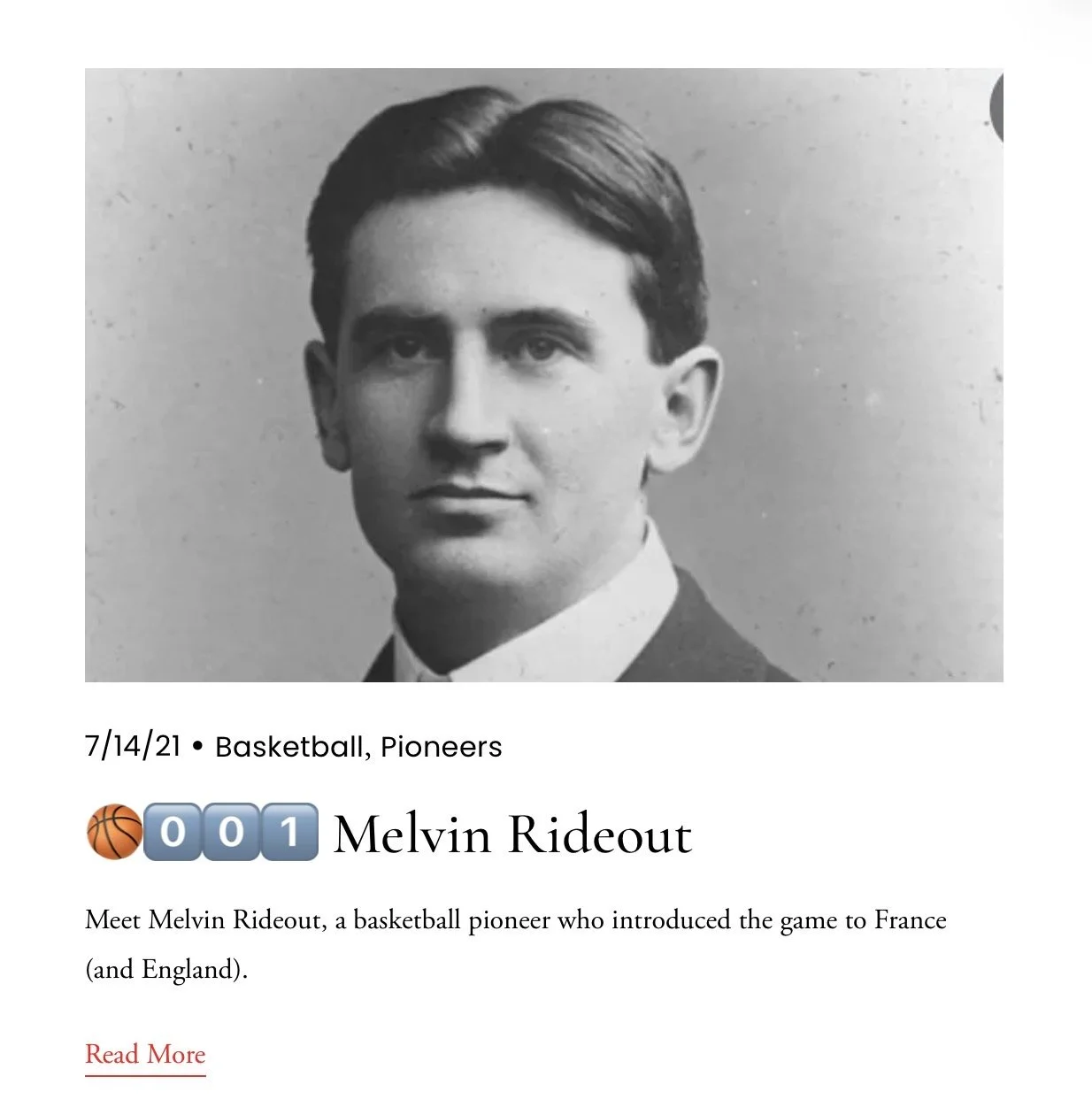
Little did 22-year-old Melvin Rideout know that his first job following college graduation in Springfield, Massachusetts in 1893, sowed the seeds of French and American sporting relations that have endured to this day.
Rideout arrived in Paris that summer to serve as the YMCA Paris Association’s first-ever physical education director. Their newly minted building, located at 14 rue de Trévise, contained an exact replica of the gymnasium at his alma mater, the International YMCA Training School (now Springfield College), down to its basketball court encircled by an elevated track.
It was opportune, for Rideout was one of the first to learn the new sport from basketball’s inventor James Naismith, his former teacher.
Rideout brought the game with him to Paris. On December 27, 1893, he oversaw the first basketball match played outside of North America on what is today the oldest surviving original basketball court in the world.
The sporting ties between France and the United States have since fostered closer relationships and understandings, strengthening and complimenting each.
What makes this story special is the multiplier effect. Sports are ways for everyday citizens to engage with and better understand each other. In the process, they learn something about their craft and about themselves, passing this knowledge on to others. These interactions pay dividends in strengthening the abilities of each country’s sporting sectors and athletes—and the Bay State has played an important role.
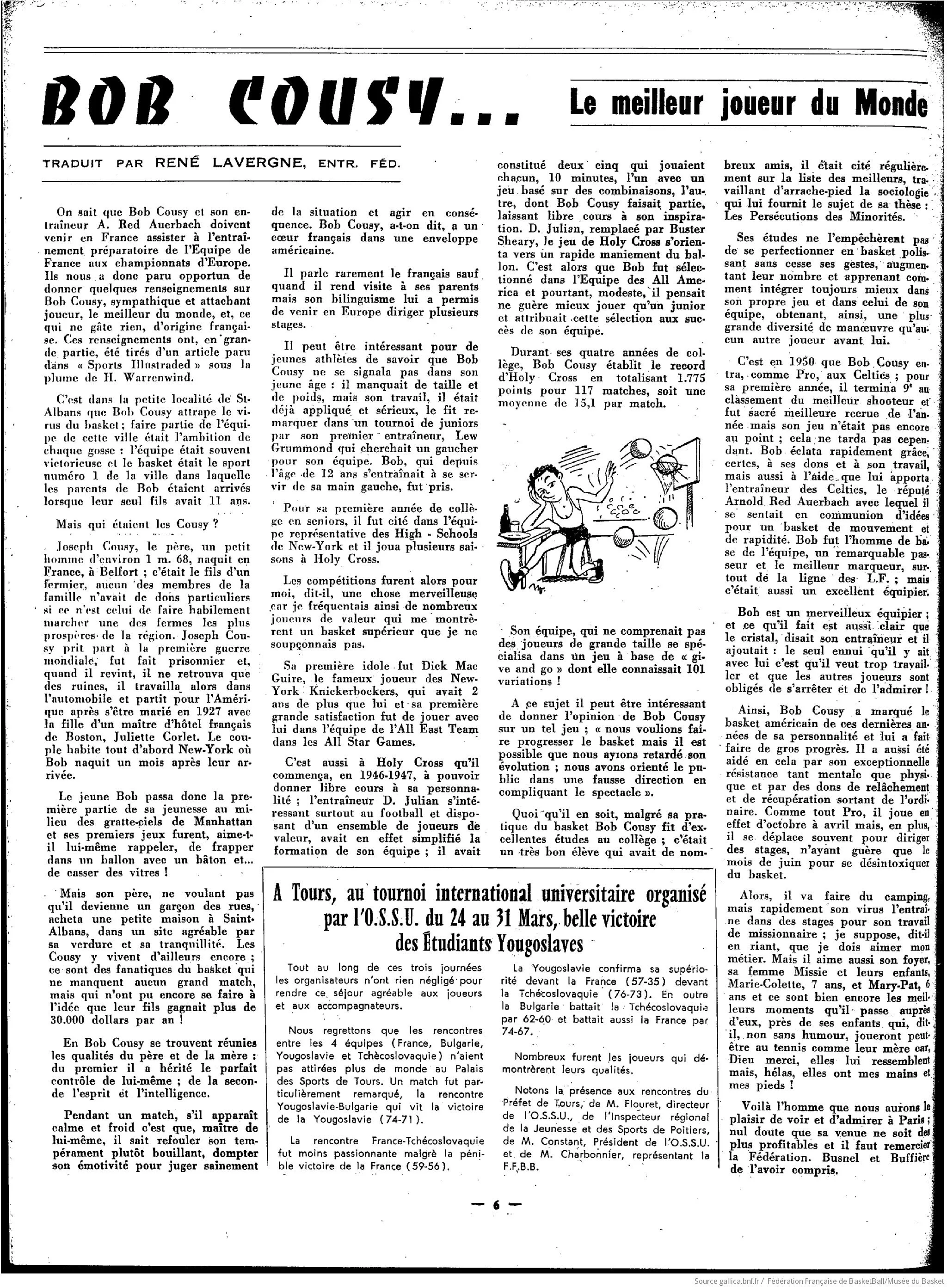
French and American basketball took different trajectories after 1893 but continued to serve as mutual points of exchange after the two world wars. A 1959 training camp for the French national team with two Boston Celtics legends proved pivotal. That May, coach Red Auerbach and his star point guard Bob Cousy visited Paris to share how they played the game. The francophone Cousy, son of French immigrants, counseled his counterparts to play less technically and more naturally with an emphasis on greater scoring. Weeks later, those same men earned a third-place finish at the European Basketball Championship (EuroBasket), Les Bleus’ last international podium finish until 2000.
Photo (below) from Basket-Ball, May 1959. Available via Gallica/BNF https://gallica.bnf.fr/ark:/12148/bpt6k5813610k/f8.item#
But it was another iconic Boston Celtic who perhaps had a more impactful effect on French basketball.
Bill Russell, an 11-time NBA champion and Civil Rights activist, rewrote the script for how to play defense. While Russell fought to win his last title with Boston in 1969, a young French player some 3,500 miles away avidly watched Celtics game tape so that she could recreate his moves and tactics. That’s how Élisabeth Riffiod learned her idol’s defensive style and techniques, which she deployed in a glittering career for France, helping Les Bleues to the 1970 EuroBasket silver, and her club, Clermont Université Club, one of the most dominant European sides of the late 1960s through early 1980s. Riffiod finally met Russell decades later when her son, Boris Diaw, entered the NBA.
American influences helped strengthen basketball in France, even as French influences have begun to do so in the United States, first in the NCAA (1984), then the NBA and WNBA (1997). This heritage traces its throughline to France’s best ambassador to North America, NBA Defensive Player of the Year Victor Wembanyama, the next face of the league.
It isn’t just basketball where the Franco-American sports story shines.
Overtime the transatlantic relationship has been built through tennis, rugby, golf, gymnastics, judo, and more—including football.
While Les Bleus discover Boston this summer, it’s former international Laura Georges whose Bay State experience is noteworthy. Long before Georges served seven years as French Football Federation Secretary-General, she was a student-athlete at Boston College. The BC Hall of Famer taught her teammates about France, its football, and its hero Zinedine Zidane. In turn, she learned how to never give up, to be more confident, and to be present in the moment while working to develop better mental toughness. These qualities she brought back to the national team. During her time en bleu, France regularly became one of the world’s top ten ranked teams and garnered a historic fourth-place finish at FIFA World Cup 2011.
Sports are an accessible space where French and Americans can engage and exchange about their countries and cultures. This historic, albeit at times hidden, pillar of the Franco-American relationship fosters sporting techniques, savoir faire, and leadership development that strengthens each country’s sports scene. The growth of the transatlantic sports economy and business sectors provides timely opportunities to write new chapters in this larger story.